Let’s talk about turnover the way executives actually experience it.
When someone leaves, it doesn’t feel like an “HR issue.” It feels like things start breaking.
Projects slow down. Decisions take longer. Mistakes creep in. Customers notice. Leaders get pulled into the weeds.
That’s risk — whether we label it that way or not.
Most organizations track cyber, financial, regulatory, and operational risks in great detail. But people risk? That often lives in a spreadsheet somewhere, if it’s tracked at all. And that’s a problem because turnover doesn’t occur as a single event; it appears as compounding exposure.
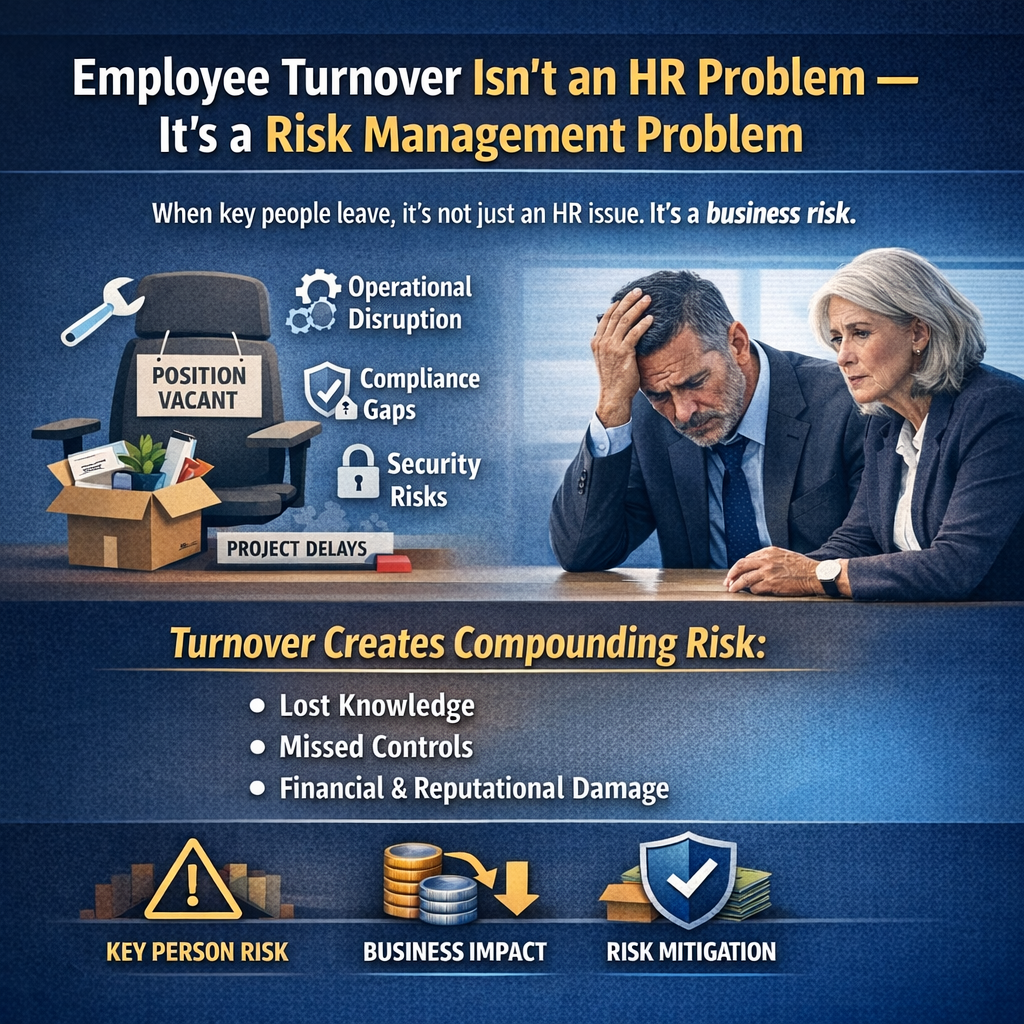
When the wrong person leaves—or too many people leave at once—the organization absorbs the impact across the organization. Operationally, work slows down and quality drops. From a compliance standpoint, controls get missed because “the person who knew how that worked” is gone. From a security perspective, offboarding isn’t always clean, and access management becomes fragile.
Financially, leaders lose time and momentum as they try to stabilize the team. Reputationally, customers feel inconsistency long before a dashboard turns red. That’s not theoretical risk. That’s lived experience.
One of the most significant warning signs is key person dependency. If your organization struggles because one specific person left — not just the role, but that individual — you already have risk on the books. You just haven’t named it yet. That’s not a people issue. That’s a systems issue.
Strong organizations don’t rely on heroics. They rely on repeatable, resilient systems. And that applies just as much to people as it does to technology. So, how do leaders reduce turnover from a risk perspective?
First, identify where the exposure is. Which roles are critical? Which departures would cause real disruption? If you can’t afford to lose someone, that’s a risk worth managing. Second, reduce the likelihood. Poor management, unclear priorities, and chronic overload increase the likelihood of turnover. Investing in leadership quality isn’t soft — it’s preventive risk control. Third, watch leading indicators. Exit interviews are too late. Look at engagement trends, burnout signals, missed deadlines, and error rates. These are early warnings, not HR metrics.
Fourth, reduce the impact. Document processes. Cross-train teams. Build succession plans. No organization would accept a system with no backups — people should be no different. Finally, govern it at the top. If turnover isn’t part of executive or board-level discussions, it’s not being managed. Risk that isn’t reviewed gets normalized.
Here’s the bottom line executives care about:
Turnover increases risk before it increases cost.
By the time it shows up on the income statement, the damage is already done. The real question isn’t, “Why are people leaving?” It’s,
“Where have we quietly accepted people-related risk — and what is it already costing us?”
That’s a leadership conversation. And it belongs in the C-suite.